


Jo Smith Pottery being made
Updated: Mar 4

Opening up a centered lump of white stoneware clay on the wheel.

Pulling up the wall, smoothing with a sponge while supporting on the inside and beginning to shape the form.

Hands supporting each other to flare out the top while narrowing the lower half of the pot.

Working as a unit, the form is refined, using the wet sponge on the outside, fingers on the inside.

Using a scraper to create a clean and smooth surface, having already created the clean edge of the foot of the pot.

The spout and location for the handle are created with careful pinching then set aside to allow for some drying.

The scraper comes into use after the pinching to form a spout, for a batter bowl.

Keeping the leather-hard pot in the center of the wheel, slow turning allows for trimming any areas around the foot that are too thick or creating a smooth bottom.

A larger tool to smooth and trim the bottom of the pot, while centered upside down.

Attaching a handle requires a measure of both soft and hard, wet and dry, in other words, just right conditions as one uses dabs of water to help attach the handle. Jo is using a specially made stamp to finish the appearance of her fluted and then applied handle.

After completely drying, the first firing turns the clay into bisqueware using Cone 04 or about 1940 degrees F. Here wax resist is painted on the bottom of the pot so no glaze materials adhere to the porous material.

Dipping into the glaze allows more than one color to be added to the pot if desired.

This dip into another color provides a design element to the piece.

Glazed pieces lined up until a kiln load has been prepared for the glaze firing.


Reaching the bottom of the electric kiln, stacking the shelves on the kiln posts, ready to build on up to the top.
More pottery to fill up the kiln, nothing must touch the sides of the kiln or the kiln furniture. Jo's high-fired stoneware fires to Cone 10 or 2400 degrees F.

After firing, unloading the kiln is fun to be surprised or reassured by all the lovely pieces.
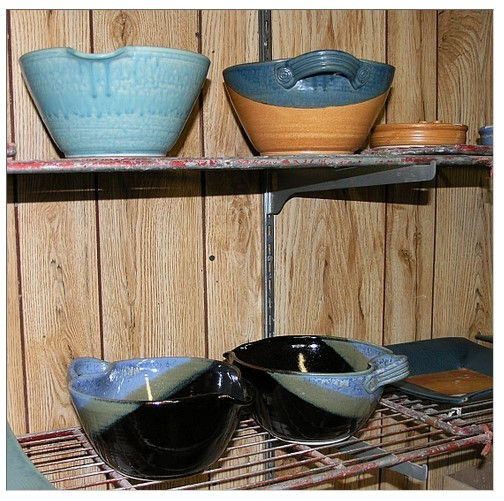
The results of 3 different glaze patterns: Rust and Teal, Blue and Brown, and Turquoise.


Comments